


More Than Meets the Eye
By Sage Surratt
Writing 105: Introduction to Critical Reading and Writing
It’s around 3 o’clock on a typical weekday in the Miller Center at Wake Forest University, a place where student athletes practice and study. Seth Youngblood is in his office located in the middle of Miller. He is a Student Athlete Academic Counselor; more specifically, he works with just the offensive football players. He is sitting at his desk in one of his weekly meetings with one of the players discussing grades and plans for the remainder of that player’s collegiate career. Seth always has a smile on his face; it is hard to distinguish if he is in gloomy mood because, if he is, he never shows it. During the day he can be spotted walking in and out of meetings between the student athletes and their tutors as well as the study rooms, making sure student athletes are being productive and completing their work. He checks his email constantly, keeping close tabs on any athlete or staff member who has a question or problem that requires his assistance. This is a man who enjoys his work and takes his job very seriously because he genuinely cares about the academic wellbeing of his athletes.
In Seth’s office is a collage of pictures with his family and former student athletes. He is a family man — except that he doesn’t have any children of his own. Many of the pictures include his wife, and some include his brother and parents. He enjoys spending time with them, among a wide variety of other activities. He is an avid skier who loves the slopes and savors the moments when he gets to ski with his family during the winter. He loves to watch all types of sporting events as well as to go hiking. He appreciates the simple things in life that he can do with his family. One of his prominent family members, who helped him find his dream career, was his role model growing up. His grandfather played a significant role in his life, always leaving Seth with wise sayings and useful advice throughout his childhood. His grandfather was a medical doctor, which is what inspired him to try and become one too. The doctor route did not work out for Seth, but he realized that he was still able to draw inspiration from his grandfather’s actions. In the words of Seth himself, “Helping people is what I gathered from him and it really inspired me to try and help other people, so I wanted to go the medical doctor route. But, that didn’t work out, so it was kind of what he instilled in me in wanting to help people and, so I was able to do that with this job.” This led to him getting into the counseling profession, where he could communicate and have an impact on people’s lives in a positive way. After graduating from N.C. State University with an undergraduate degree in psychology, he decided to attend Clemson University to obtain his master’s degree in counseling. With his passion for helping people through counseling and his love for sports, Seth found this job as a way to combine both: “I really love sports and athletics and, you know, I just kind of found the way to merge counseling and my love with sports.” He enjoys working with athletes, being able to impact their life through academics, and ultimately helping them find their path towards a successful future.
A typical work day for Seth begins at about 8:30 in the morning. He essentially helps to supervise all the operations that are being conducted in the Miller Center. He communicates with tutors, athletes, coaches from the football team, and any other faculty at Wake Forest who work alongside the student athletes. Throughout the day, he is in his office performing any type of service that is needed from him. Athletes will stop by his office at different times during the day to have a meeting with him about their academic performance so far throughout the semester. He checks on their grades and tells them about any opportunities or things they could do bring their grades up if they are not doing well. He is also responsible for reporting players to coaches if they miss tutoring sessions. He can be spotted in his office most of the day or seen walking around making sure students are studying in the study rooms. He occasionally walks in on tutoring sessions making sure everything is going well. He has different hours depending on the day, which he says is the only aspect about his job that he dislikes. In his words, “I probably would dislike the weird hours and nights where the work starts to wear on you, from deadlines to request from coaches.” Typically, he leaves the office at 5 o’clock, but sometimes the advisors must rotate monitoring the freshman study hall room until 9 o’clock. If a sport is having a home game during the week, he sometimes will attend it, which can result in him leaving campus at 9 or 10 o’clock.
Seth’s job is a critical part to many student athletes’ college careers that is often overlooked, simply because many people don’t realize the extent of dedication that is required for both him and his athletes to succeed. He makes sure student athletes needs are taken care of, from books for class, to class registration, to helping them pinpoint the courses they need to graduate. His skillful organization helps him make the job look easy. He knows almost every piece of information that is needed for athletes and is more than willing to go beyond what is required to assist someone. He looks at the bigger picture/goal for himself and student athletes when he performs numerous tasks. “Once they put in a lot of hard work, it’s great to see them get their degree. So just seeing people come full circle and getting their degree brings joy to me,” he says. Seth makes an impact on student athletes’ college careers that may be overlooked in the bigger scheme of things.
In Seth’s office in his collage is a photo of himself and one of his former student athletes whom he advised. The photograph was of Seth and Jon Williams standing outside of the Miller Center; Jon had his graduation gown on with his arm on Seth’s shoulder smiling into the camera. Jon was a former wide receiver for the Demon Deacons and the photograph resembled what the job meant to Seth– building relationships with student athletes by helping them find their path and complete their milestone of graduating from Wake Forest.
A Word from Sage
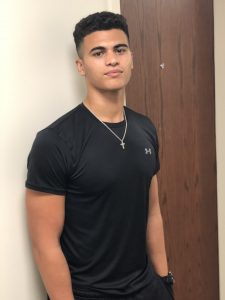
I have always had a true affinity for the game of football. It was always a dream of mine to play in college, and I was ecstatic when I received the opportunity to play at Wake Forest University. Being a student athlete, however, is much harder than most people can imagine. So many grueling hours of practice can take away from academic study time and add copious amounts of stress to the lives of these student athletes. I feel that it is important to acknowledge the phenomenal support system that student athletes have at Wake Forest.
By writing about something I am so familiar with, my writing seemed to flow almost effortlessly. I think that writing about one of the key members of the student athlete support system was important because it goes to show the difficulties of a student athlete’s day but also the true compassion that people like Seth Youngblood possess.
The opportunity to write about this topic has changed my confidence level in my writing. Having the opportunity to have this piece of writing published caused my confidence to skyrocket. I initially viewed my writing, coming into college, as more or less average, but this assignment has shown me that writing about something or someone I am passionate about brings out some of my best writing. With the help of my professor, Phoebe Zerwick, and all her corrections, she helped me to achieve a strong essay that accurately depicts the amount of hard work that counselors, like Seth, put in to ensure that student athletes are successful both on and off the field.
From Professor Phoebe Zerwick
Assignment
“Working at Wake Forest” Profile
Students often refer to Wake Forest by the nickname “Work Forest.” That nickname is meant as a complaint and a statement of pride about the academic work required of students. What about the other work that takes place on campus? The work of cooks and maintenance workers, lab assistants and tutors, work that often goes unnoticed. In this assignment, you will explore the complexity of work at “Work Forest” by interviewing someone who works on campus and writing an essay about that job.
This assignment is designed to give you practice with close reading and using evidence to support an idea. In this case, your evidence will be drawn from the interview you conduct with someone who works at Wake Forest. The transcription of the interview will be the “text” you use to write a profile about that person and the job. The assignment is also designed to help you think about building a larger argument. You will use the transcript for a later writing assignment and again, at the end of the semester, when we will produce a class blog titled “Work Forest” using the interviews each of you conduct.
If this all sounds too complicated, don’t worry. I have broken the assignment down into straightforward parts.
1. Pick a job you want to profile, contact that person now and
arrange an interview, in person.
2. Write a list of interview questions to review in class.
3. Record the interview and take a picture of your subject or of
something that signifies the job. Be sure to back up the interview
and the picture to your computer. Post the image to the class
Tumblr blog.
4. Transcribe your interview on the sheet provided. You will
practice close reading in class using the transcript as your text.
5. Write a 2-3 page profile about your subject and the work he or
she does using the transcript as your source of evidence.
Professor Commentary
Sage Surratt’s profile of Seth Youngblood provides a close-up view of a position that is often overlooked on campus but is so critical to the lives of student athletes. The assignment, early in the semester, in Introduction to Critical Reading and Writing, is designed to give students practice with evidence, close reading, and concrete language. I find that students respond well to conducting an interview as a form of research. And they see through the transcript they create how to use quotations, the voice of another speaker, in their work. It was clear from Sage’s interview that he conducted a thoughtful interview with Seth and he used Seth’s words well in the profile, making good use, for example, of the following to reveal something of Seth’s voice and character: “Once they put in a lot of hard work, it’s great to see them get their degree. So just seeing people come full circle and getting their degree brings joy to me.” Students often fall back on generalizations and platitudes, especially during their first semester. It was refreshing to read Sage’s prose, which relies on specific nouns and active verbs. I also admire the attention Seth gives to the structure of his writing, a skill that will serve him well as he tackles more complex assignments with more nuanced arguments.