

Down to Barn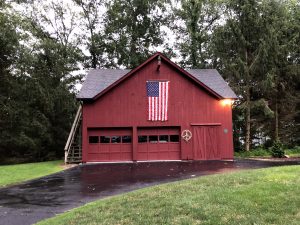
By Laurence Roberts
Writing 212: The Art of the Essay
Some twenty odd years ago, my father decided to build a barn on the western wing of our property. At the time, he was a custom cabinet maker. A carpenter, although my mother corrected me whenever I referred to him as such. His profession granted him both the desire and the skill to construct a barn. His cabinet-making business, consisting of himself and a close friend, currently operated out of a distant and cramped shop that struggled to manage their increasing orders. Laurence Nelson Roberts Sr., to whom I am Jr., was a problem-solver and a woodworker, and so he built his own office.
It was a tidy spot; a recent effort to clear much of our two-acre plot of the ever-dense Connecticut maples and birches left this rocky rectangular patch eager to be developed upon. An electricity transfer station flanked the back edge of the section, prominently marked by Connecticut Light & Power’s steep chain link fences, trespassing warnings, and security cameras. These measures never were all that necessary for the ominous hum of the machinery and a gossiped fear of radiation poisoning were enough to deem every baseball tossed over as gone forever. The Sandlot kids never had to face the hand of modern engineering. To the right, a meager stream passed under our driveway and meandered into a drain pipe as it left our property, an attempt by CL&P to preserve the ecosystem upon which it had laid its growling metal dogs. Our driveway extended across the front face of what would become the barn, a convenient place for a two-door garage, and curved away towards our house at the southwestern corner. A few remaining pines hid the left edge of the rectangle from the bustle of the nearby roadway.
The two-story structure was finished with a distinct deep red color somewhere between rusty and maroon, referred to at the local paint store simply as Barn Red. The glistening navy shingles of the A-framed roof were the only part of the barn spared from a number of coatings of this Barn Red. Two garage bay doors arrived with clean white panels and were subsequently doused with the color. It was a handsome look and it contrasted well with the soft blues and whites of our quasi-Saltbox styled house, or so my father argued. His obsession with that red seeped into the front and back doors of our home, the chicken coop, the gates of the vegetable garden, the tool shed, even appearing as the predominant color of the local firehouse he would design years later.
A three-foot-long perch of sorts, another item thoroughly caked in that red, jutted out near the pinnacle of the broad front face of the barn. After a string of attacks on our hens by various birds of prey, my father placed a cautionary plastic owl on the perch as per advice from a farmer’s magazine. I’m still not quite sure if this measure made any difference or if the murdering hawks were simply replaced by bloodthirsty foxes. Just underneath it, an auxiliary door to the second floor opened into thin air, an addition that served little use other than maintaining the structure’s rural American aesthetic.
In the left bay of the garage sat an International Harvester tractor that my father had purchased off of eBay. He claimed it would assist him in landscaping the property and in removing the pesky and plentiful boulders found in all Connecticut soil. Years of rust, oil residue, and dirt dulled the red (a lighter and more eccentric red than Barn) of its long arms and bucket. My memories of that tractor, affectionately named Bertha after the song by the Grateful Dead, include remarks at its awesome power and confusion at its many malfunctions. Bertha assisted in clearing our treacherous driveway after more than a few nasty Nor’easters and snowstorms. On these days, my father would exhaust a can of starter fluid into the engine cover and pray for any semblance of the tired grumbles Bertha would emit before roaring awake. We would get maybe two hours of use out of her before a bolt jumbled loose or the motor overheated. Weeks would go by before Bertha could be asked to work again. In the meantime, my brother and I brought cans of Diet Coke Lime and, if the sun had set, a bottle of beer to the barn to relieve my father of his repair efforts.
The opposite bay held another one of my father’s prized possessions, his pale blue 1966 Mercedes-Benz 200d. It was another eBay purchase, one he had driven hundreds of miles early one Sunday morning to retrieve. The previous owner had christened the car as Eleanor and had requested that we keep the name, just as one does not rename a boat. I was never able to drive Eleanor. Not only did the car have a manual transmission, the gear shifting was done with a handle attached to the steering column. Instead, my brother and I would lounge in the yellow and blue checkered-back seats messing with a Sony Bluetooth speaker that my father used to replace the broken radio, astonished at how seatbelts were not a priority for the auto manufacturers of the 1960’s. The vehicle’s gas gauge had gone defunct long ago but my father knew that Eleanor managed somewhere around 10 mpg on a good day. On Sunday mornings, we would fill her up and crawl to Compo Beach for breakfast on a bit of luck and a lot of hope.
I liked the role of the messenger boy. Some nights, my father would be spraying paint or sanding wood in the barn until I informed him that it was time for dinner. His machinery muted the sounds of my mother’s shouts from the porch, so she sent me to knock on the door. My father would emerge from his workshop dressed in what I could only interpret as a hazmat suit, a sort of gas mask covering his face and wood shavings littered all in his hair. I would help him out of this apparel and lead him inside. Sure, a text message could have sufficed. But this was my job, and I wore my badge with pride.
One Christmas morning, St. Nicholas dropped off a cool pair of Baja 70cc dirt bikes. Emblazoned on the front of each were racing numbers that corresponded with the day of the month on which my brother and I were born, he the 17th and I the 18th. These motorbikes found a home in the barn in an empty space next to the garage doors. There they sat for far longer than my father would have liked; my brother and I were too young to have the confidence, size, or ability to champion the beasts. However, during one particular summer the bikes saw near daily use. Much to my mother’s protest, I would cruise up and down our desolate street on my steed, making occasional stops at the gravel parking lot of the town’s Historical Society at one end. Other times, I would muster up the spunk to sneak away to my friend’s house a few streets away, vigilantly looking out for the perennially-absent local police officers. My comfort on this gas-powered toy was only stunted by the occasional nasty burn on the muffler or a wipeout. The late sunsets of this summer, or an injury, or nearly one, called for me to return to the barn. I would glide through the garage doors and knock the kickstand out, removing my helmet and flipping my hair back as if I had just completed some cross-country motorcycle excursion.
The second floor of the barn became a place for my adolescence to blossom. The staircase to this lair, a plain wooden structure that creaked with every step, ascended from the left side. In the early years, a pungent second-hand couch fielded many hours of PlayStation and naps in the warmth that seeped in through the skylights. Later, that room served as a private getaway for the few girlfriends that my brother and I secured. It was rather oddly shaped; the pitched roof of the barn left this room with sloping ceilings that were the cause of many injuries that prematurely ended vivacious games of ping pong and billiards. Soon, our teenage selves recognized the value of such a place and more properly adorned it with a large TV, an even larger stereo system, and a sectional couch that was free of odor. Our parents mistakenly revealed to us that they could not hear the music we played from their bedroom in the house, a welcome admission that only served to damage our ears even further. Late nights of sneaking to this floor of the barn with friends opened our eyes, and our mouths, stomachs, and lungs, to the substances introduced to us in the latter years of high school.
The main door to the barn latched with a metal rod and socket. One would have to press on this door with the whole of one’s body to even have a hope of fastening these two pieces. Most days, the door remained wide open with the help of the same ancient two-by-four. My father always played music as he worked, and leaving the door ajar announced that he was inside and open to visitors. The inner face of this door was decorated with a variety of Grateful Dead merchandise: a “steal your face” sticker, a few dancing bears, even the scraps of old concert tickets that he had managed to preserve. My father had repurposed a small mirror from the sun visor of a car and fastened it to the door at eye-level, the closest thing the barn had to a bathroom vanity. A soda cap that made some prophetic claim about beauty was nailed to the right of the mirror. I remember the barn from the frame of that door, looking in at my father tinkering on the tractor or the car or the dirt bike or a piece of furniture. I picture the garage doors wide open and a summer breeze lazing in to cough up piles of sawdust. I smell years of paint and lacquer, gasoline and starter fluid, grease and fertilizer. I hear bits of Bertha the song and Bertha the machine, fighting each other for predominance. The barn was constructed for the furnishing of cabinets, the cleaning of carburetors, the maintenance of engines, and, perhaps unintentionally, the making of men.
A word from Laurence
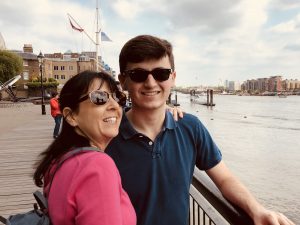
Dr. Erin Branch’s WRI 212 course, entitled “Literary Nonfiction: the Art of the Essay”, provided me with the academic and social setting I needed to be able to produce pieces of writing like “Down to Barn”. For me, creative writing had always been too personal, too lyrical, too unrealistic or too unimportant. Upon reflection, these claims may have all been covers for too difficult. I regarded myself as a proficient writer and wrote off struggles with the creative genre as issues with the creative genre. Dr. Branch’s course wiped away those unfounded accusations and enabled me to uncover my own writing weaknesses in the comfort of twenty or so other unabashed young writers. For these revelations and so many others, I am forever indebted to my professors Dr. Branch, Dr. Ryan Shirey, and Dr. Linda Nielsen as well as my faithful peer editors Margaret Horsley and Sebastian Pellejero.
I do not necessarily think that “Down to Barn” is important in any particular way. I would shoo off any readers looking to it for a genuine dive into my character or some prophetic account of suburban life. It is more a varied collection of thoughts on and memories of my family’s barn. Visions of my family poking holes in the essay for some eager sweetening of certain details or dishonest recordings of childhood memories plagued my writing process. I remember, fondly now, impulses to verify the dimensions of the building and the property with an official plat. Pushing through these hesitations allowed me to produce a version of “Down to Barn” that was consistent with my own memory and wishes, completely valid or not.
I will include here a headnote for this piece that I wrote for an essay anthology (composed in partnership with Margaret Horsley) entitled What is the Good Life?. I encourage you to take it in jest:
“Laurence Roberts (1998– ) was an undergraduate student at Wake Forest University when he wrote his critically acclaimed (although never published) essay “Down to Barn”. His childhood years were spent amongst the forested hills of the town of Weston, Connecticut in the company of packs of Rhode Island Red chickens, a few Labrador Retrievers, a Leopard Gecko or two, and, of course, the goldfish he won at the Memorial Day Carnival in 6th grade, Laser. Laurence attended Weston High School, graduating in 2016 somewhere near the top-middle of his class, and subsequently relocated to the tobacco country of North Carolina to pursue interests in Philosophy and Writing. He accredits his interest in literature and supposed skill in essay writing to his Humanities teacher, Mr. Michael Mezzo. The piece included here follows in both style and theme with much of his other creative writing; each page drips with undue confidence in word choice and some mixture of sweat and tears smeared onto the keyboard with a misjudged wipe of his brow.”
From Professor Erin Branch
Assignment
Essay #3: Your Choice (among recent genres)
Since mid-semester, we’ve read a wide range of essays–mostly from the American context, but a few from beyond–that participate in a number of essay sub-genres, including place-focused essays (like John McPhee’s “In Search of Marvin Gardens” and Momaday’s “The Way to Rainy Mountain”), portraits (like Natalia Ginzberg’s “He and I” and Scott Russell Sanders’ “Under the Influence”), as well as contemporary essays ranging from cultural criticism (Susan Sontag’s “Notes on Camp,” Robinson’s “Imagination and Community” ) to reportage (Jamison’s “Fog Count,” Kolbert’s “The Sixth Extinction?”) to lyric (Gann’s “Wrongful Birth,” Haile’s “Going it Alone”) to meditations on the nature of truth and fact in the essay (D’Agata & Fingel, Karr). The remaining weeks will offer even more of the delights of what some critics have called a golden age of essays.
For your last stand-alone essay, you choose which subgenre you’d like to try out. Whichever you choose, I recommend re-reading potential models (not for style or content, necessarily, but for ideas about the rhetorical features of (say) a portrait vs. reportage. Your essay should be 5-6 pages long.
You may also try your own meditation on the kinds of genre-based distinctions we’ve been drawing and erasing all semester, or on the nature of “truth” in non-fiction.