


While Facing Trials and Succeeding: An Auto-ethnography of Being a Female, First-Generation, Mexican-American College Student
By Arisbeth Camarillo-Reyes
Writing 111: Writing Seminar
My parents always stressed the importance of education. If I didn’t take advantage of the free education offered here in the United States, I would end up with a low-paying job, and I would have to endure similar struggles as they have. “No quieres terminar como yo” (Parents’ Interview, personal communication, April 7, 2018). “You don’t want to end up like me.” I have heard this saying throughout my whole life from my parents, aunts, and even from the cleaning staff at Wake Forest, where I’m now in college. As a child, I never understood what they meant by that saying. I had grown up idolizing my parents and their hard work. I thought everyone’s parents woke up around four in the morning to go to work and would come home around five in the evening. I am the eldest daughter of Mexican immigrants. I am also a first-generation college student. Growing up, I had always been surrounded by people of color, people who looked like me, and to whom I could easily relate. At school, I was lucky enough to have supportive teachers who encouraged me to continue to pursue college. Before high school, I had no plans as to where or how I would attend college, but, as the years progressed, I continued to excel academically. I would ask my teachers and counselor how to apply to colleges and receive financial aid. I remember my classmates asking their parents how the college process worked because they had gone to college. Since my parents did not have the opportunity to do so, I could not rely on them to help me. But, I managed to get into Wake Forest University with the help of my teachers, counselors, and the unconditional support of my parents.
I grew up in Winston-Salem, North Carolina. According to the United States Census (2010), the total population of Winston-Salem is around 230,000 people. The population is 51.2 % white, 34.7% black, and 14.7% Latino/Hispanic. (2010). Although a significant portion of the population is white, I lived on the southside of town, which is primarily composed of Mexican and black individuals. Until about the age of five, all I had heard was Spanish. I learned how to speak English in preschool. Everyone in my neighborhood knew each other, and we spoke Spanish. Until college, I had attended schools that were primarily composed of people of color, including the student population and faculty. I was always comfortable around them, and I related to most of my classmates. Their parents were also immigrants from Mexico or Central American countries, which allowed us to connect on a cultural level. In high school, most of our conversations were in Spanglish, a combination of English and Spanish. So, when I applied to college, everything was a new experience for my family and me. I filled out my college applications and FAFSA by myself.
I also didn’t know a lot of people who had gone to college, so I didn’t know what to expect once I got onto campus. There was a definite culture shock; never in my life had I been surrounded by so many white people. According to the Wake Forest 2016 Fact Book (2017), 71.3% of the first-year students were white and 7.6% were Hispanic/Latino (p.1). Everything was different; conversations seemed to lack substance. Back home I could relate to the people on a cultural level; we enjoyed similar music styles, or we could talk about how good the carne asada (cookout) was at a family function that past weekend. I realized that I could relate more to the cleaning staff here at Wake Forest than to my own peers.
From my experience, Mexican culture is centered around family. Being Mexican has always been a great part of my upbringing and has shaped who I have become. As Gordon Allport suggests in The Nature of Prejudice, being a female, first-generation, Mexican-American college student is an ingroup that I belong to, and, as Allport (1954) would say, this is a mixture of an achieved and ascribed status, a group that I was born into, and a group I joined through my academic success. In college, I felt lonely, I missed my family incredibly, and I also felt guilty, but not due to my academic success. As suggested by previous research by Covarrubias, Romero, and Trivelli (2015), first-generation students feel guilty about their academic achievements when their family members have not had access to higher education. I felt guilty for leaving them because growing up I would take care of them, which is common in Mexican families. Females in the households oversee the upkeep of the household. I focused on my family’s needs instead of my own. Some of the customs that my family, and other Mexican families practice, allow for machista behavior to pervade. Men and women provide for their provide for their families, but women have the additional task of being caretakers of their children and the upkeep of their household. In Mexican households, gender is pertinent to the roles one will assume in their household. At home, I would help with the upkeep of the house, help my siblings with their homework, translate things for my parents, and help my parents in any other way. We relied on each other for the household to work properly. Over the years, my family has attempted to overcome these stagnant gender roles. My family has always supported me and my academic endeavors. Although work at home was heavy, I understood that my role in the home was important. But, when I came to college, everything changed— the dynamic of my family changed.
Muñoz and Maldonado’s research (2014) on college persistence asserts that Chicana/o college students rely on and gain strength from their families and communities (p. 295). I gained strength from my role in my family. I knew that they needed me. They relied on me to help them in the household. Once I was taken out of my role and inserted into college, I felt like I had lost a piece of myself. I didn’t feel quite as important as before. I felt like my role didn’t matter anymore; therefore, they didn’t need me anymore. This was a very lonely time for me. Pratt, Harwood, Cavazos, and Ditzfield’s research (2017) on the retention of first-generation college students emphasizes that non-traditional, first-generation college students (e.g. Asian Hispanic) learn to place the role of group member over individual. This accentuated the feeling of loneliness; I was surrounded by people who didn’t look like me or couldn’t relate to my experience did not help.
Experiences such as my own and of other Latina women should be acknowledged due to the growing Latino population in the United States. According to the Pew Research Center (2017), the Latino population in the United States was 58 million in 2016, making it a principal driver of U.S. demographic growth. Latinos are also increasingly attending institutions of higher education. The Pew Research Center (2011) confirmed that about 12.2 million Latinos were enrolled in either a four-year or two-year higher education institution. Previous research such as Covarrubia et. al. and Muñoz and Maldonado have suggested that first-generation Latino students face issues of adjusting and coping with the new-found experiences of college. This often results in feelings of isolation, depression, and guilt because they do not count on the familial resources to guide them through struggles that students face while in college. I am not saying that I’m the first one from my community to go college– but maybe one of a handful of girls in my community. I feel as if my experience should be used to make it easier for everyone else now that I’ve passed the test of my first year.
Holding Back: The Struggle of Being Brown and Being Good Enough
Academically, I persevered because I didn’t have to focus on my family– my parents made this clear. They didn’t want me to worry about them. They’d tell me that I should focus on my studies so that I could succeed and become ‘better’ (interview). Once I had gotten on campus, I realized that, although Wake speaks a great deal about being a diverse campus, it’s not. I noticed that my classes were predominantly composed of white people. I had never been in an academic setting composed as such. I felt out of place and that I somehow had to prove myself worthy of being at Wake Forest University. I felt apart from my fellow peers. More specifically, when subjects such as immigration or race were brought up, I felt like I must speak up. Then I have to take into account the negative repercussions that this could entail.
It does not bother me to speak up for marginalized groups, but it should not fall onto me to express such broad perspectives. I cannot also share everything about myself because of the potential repercussions that my family could endure due to me living so close to home. I myself am not undocumented but people in my family are, so I cannot express openly how this has affected my experience growing up. Muñoz and Maldonado (2012) mention that finding a sense of belonging requires undocumented students to conceal their legal status and students find a way to neutralize the dominant perspective that categorizes them as illegal and not belonging. Thus, I feel like I can’t be completely open about who I am with my peers. Although I am not undocumented, I still feel as if I must keep certain things about my family left unspoken. I am not completely comfortable in the school environment here at Wake. This is something that I think about subconsciously in class. This has affected the way I perceive myself. I started to doubt my academic abilities. I thought I wasn’t good enough because people like me don’t go to college. People from my old neighborhood had not gone to college– after high school, they usually got married and would start working to support their families.
So, I do agree with Covarrubias, Romero, and Trivelli’s research (2015) which affirms that the stress minorities have about their academic concerns and negative perceptions of the campus climate contribute to depressive symptoms. As I have mentioned before, I cannot speak for every first-generation, female, Mexican-American college student, but I can say that this female Mexican-American perspective should be acknowledged. From my experience, higher education institutions should accommodate to the needs of Latino/a and other minority students to make it easier to bridge the cultural gap that exists between minority students and predominately white institutions. Covarrubia et. al. (2015) suggests that first generation Latino/a college students have different experiences compared to white people who predominately compose higher learning institutions. We are more prone to face discrimination due to our appearance; we are more family-oriented, making it hard to leave home; many of us face more difficulty paying for school, and that is why we often have a difficult time finding our own place on college campuses; many of us are more focused on paying for school rather than enjoying the full college experience.
The higher education institutions that we attend should acknowledge the difficulties that Latino first-generation college students face to make the college transition easier. These institutions are supposed to help us reach our academic and social potentials– but how can students do so if they’re focused on how they’re going to pay for next semester’s tuition because they can’t rely on financial help from their family, or how lost they feel without their family being there for them as they have always been? Their successes are important. Their experiences matter too.
It’s Your Job to Take Care of the Kids: Life after Leaving Home
Covarrubias, Romero, and Trivelli conducted research on the academic persistence of Mexican women (2012). In their interviews, the women saw that, although they had achieved so much academically, once they returned to their homes they had to conform to a more traditional gender role, such as cleaning and cooking, while the males of the home did not help in the upkeep of the house. This is not an uncommon task to endure as a female in a Mexican-American household. One of my closest friends, Irais, is also a first-generation Mexican-American college student (April 7, 2018) and took on the role of caretaker while growing up. She shares a similar experience with me as an older sister,
“Being the eldest daughter, I have had more responsibilities; as a girl, this task has been very demanding. Including household chores, I was also taking care of my siblings. It’s harder being a girl in a Mexican household— gender roles are defined early on in life. Women are limited in ways men are not. For example, if I were to go out to the store, my parents would insist that I take a guy so that he could take care of me. Now that I’m getting older, I feel even more attached to my siblings. Now that I work, I provide them with things that they want if they see it at the store or things like that. It’s like the tasks of being a mom— I pick them up and drop them off from school and that also includes having to discuss menstrual cycles with my younger sister.”(Irais, Castillo, personal communication, April 24,2018)
Growing up like Irais, I have always taken care of my siblings. I have a younger brother named Anthony, who is now fifteen years old and is on his high school’s track team. I have three even younger sisters: Leylany, who is twelve and likes to draw; Yenedith, who is eleven and likes to talk a lot; and Jasmine, who is three and likes to dance, sing, and run around the house. I’ve taken care of my brother since I was ten years old. My parents would go to work around five in the morning, but not before leaving my brother and me dressed and ready for school. We would watch TV before school, get our backpack, coats, and we would walk to the bus stop and wait for it to arrive. Once we got to school, I would take him to his classroom and tell him to be good and to learn something new. I did the same thing for the rest of my siblings. I was present at parent-teacher conferences to help my parents translate so that they could understand what was going on with their children academically. I helped my siblings do their homework. This is an experience that many Mexican and Mexican-American daughters endure as they grow up. Research by Kline, Killoren, and Alfaro (2016) confirm that Mexican-American college studenta are psychologically controlled by their parents, who have shaped their morals as they have grown up.
As I have grown older, I now see how important a role my parents have played in my life. They have instilled familial values I believe will persist throughout my adulthood, and that is something that I would like to preserve. But differing from Kline, Killoren, and Alfaro (2016), I didn’t see my parents as being controlling people. They encouraged me to take care of my siblings so that I could become more responsible, learning how to prioritize the needs of someone else rather than my own. Selflessness is something that is expected from our family members. College is a very individualistic time. Students focus on their academic, intellectual, and physical wellbeing to an extent that first-generation Latino college students have probably not experienced. To assure that first-generation students are receiving the highest level of support from their institutions, they must work collectively to address what can be done to improve how the institution receives first-generation Latino college students. An example of such support would be having a more visible Latino faculty who are not just the cleaning staff. This would provide them with a system of support that resembles them and will provide them with a sense of hope.
Conclusion
My experience and the experiences of the three people interviewed cannot completely demonstrate the complexities of growing up as a Mexican-American female, and eventually becoming a first-generation college student. Being in a completely different environment with people who rarely share the same experience as I do makes it difficult to be successful; this should be acknowledged. Our experiences should not be forgotten but should be used for the improvement of future generations. Higher-level institutions should attempt to bridge the cultural gap by creating more inclusive environments and support groups for minority students, and by having a more racially diverse faculty. Breaking barriers is extremely difficult, but the universities that we decide to attend should strive to make us feel truly included in the academic and social setting. We have worked extremely hard to get to the places we have gotten to.
I want my experience as a first-generation Latina college student to become known because it might just give someone hope that getting a higher education is possible. My experience probably does not encapsulate the experiences of other women, but if I hadn’t seen someone similar to me I would have had an even harder time adjusting. With the knowledge that I now hold, I can help lead other people in my community to reach new heights in the academic realm, such as starting a mentoring program for first generation Latina college students to provide them with access to knowledge otherwise not easily accessible.
References
Allport, G. W. (1954). Formation of In-Groups. The Nature of Prejudice (pp. 29-47). Cambridge, MA: Addison-Wesley Pub. Co.
Bureau, U. S. C. (n.d.). American FactFinder – Results. Retrieved May 1, 2018, from https://factfinder.census.gov/faces/tableservices/jsf/pages/productview.xhtml?src=CF
Covarrubias, R., Romero, A., & Trivelli, M. (2015). Family Achievement Guilt and Mental Well-being of College Students. Journal of Child & Family Studies, 24(7), 2031–2037. https://doi.org/10.1007/s10826-014-0003-8
Fact Book 2016-17. (2017). Retrieved April 11, 2018, from https://ir.wfu.edu/fact-book/2016-17/
Fry, R. (2011, August 25). Hispanic College Enrollment Spikes, Narrowing Gaps with Other Groups. Retrieved May 2, 2018, from
Gramlich, John. “Hispanic Dropout Rate Hits New Low, College Enrollment at New High.” Pew Research Center (blog), September 29, 2017. http://www.pewresearch.org/fact-tank/2017/09/29/hispanic-dropout-rate-hits-new-low-college-enrollment-at-new-high/.
Kline, G. C., Killoren, S. E., & Alfaro, E. C. (2016). Perceived parental psychological control, familism values, and Mexican American college students’ adjustment. Cultural Diversity & Ethnic Minority Psychology, 22(4), 524–532. https://doi.org/10.1037/cdp0000096
Muñoz, S. M., & Maldonado, M. M. (2012). Counterstories of college persistence by undocumented Mexicana students: navigating race, class, gender, and legal status. International Journal of Qualitative Studies in Education, 25(3), 293–315. https://doi.org/10.1080/09518398.2010.529850
O’Neal, C. R., Espino, M. M., Goldthrite, A., Morin, M. F., Weston, L., Hernandez, P., & Fuhrmann, A. (n.d.). Grit Under Duress. Hispanic Journal of Behavioral Sciences, 21.
Pratt, Ian S., Hunter B. Harwood, Jenel T. Cavazos, and Christopher P. Ditzfeld. “Should I Stay or Should I Go? Retention in First-Generation College Students.” Journal of College Student Retention: Research, Theory & Practice, February 5, 2017, 152102511769086. https://doi.org/10.1177/1521025117690868.
A Word from Arisbeth
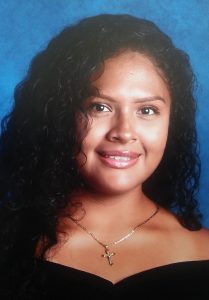 The summer of my junior year of high school, I was part of a creative writing program known as Authoring Action. I began to write with my emotions, and ultimately about my personal experiences. I started writing about my experiences ranging from being the daughter of immigrants to being a first generation college student. It helped shape my perception of the world and myself. It gave me a boost of confidence in my writing and myself. I recognized the power of words. I explored the possibilities that my writing brought forth while partaking in a narrative exercise known as a stream of consciousness. My writing and I evolved that summer. But somehow, I couldn’t translate this sort of free flow writing to my academic writing. I struggled for some time with forming a well-constructed argument in the academic setting. In my Writing 111 class with Dr. Giovanelli, I learned a way to bridge these seemingly two different worlds of writing—which I thought would be impossible. I fused my writing full of emotions and experiences with well-constructed arguments backed by scholarly sources. This improved my writing astronomically. I understood that writing was a never-ending process that could always be improved.
“While Facing Trials and Succeeding: An Auto-ethnography of Being a Female, First-Generation, Mexican-American College Student” was the first piece of writing that I had produced in the academic setting where I used my voice unapologetically. My research was one of the most surprising parts in my writing process. I learned that other young Latina women were experiencing feelings of isolation and a sort of separation anxiety while away from their families. As I wrote, I wanted my audience to know that I am all but one person, one experience. Although Latinos are a small percentage of the student population at Wake, the ever-growing population can relate to my experiences to some degree. While I wrote, I felt that Wake spoke a great deal about being a diverse campus, only about 12% were people of color in the 2017 freshman class. I continue to think that Wake speaks about inclusion but does not take firm steps towards inclusion and diversity. This is my opinion as of now. I want to keep the conversations going. I want young Latina women and other women of color to know that their opinions are valid in every setting and especially academia.
From Professor Laura Giovanelli
Assignment
Click here for a pdf of Arisbeth’s assignment.
Professor Commentary
On her three students, Arisbeth, Cassie, and Anonymous
There’s a consistent, urgent question my first-year writing students carry to class: “Am I allowed to use “I” in my writing?”
Well, I say, that depends. What are you trying to do with that writing? What’s your purpose and audience?
Even with that rhetorical framework, I understand their hesitation. Wake Forest students know the academic writing rules they learn in high school inside and out. At the top of the list: never, ever use first person. Writing about yourself can feel indulgent, overly based in emotion and individual experiences, just wrong. We squirm in our seats just thinking about it!
And yet.
Under the right circumstances, using your specific stories and lived experiences as a writer can be empowering. And combined with other kinds of evidence—academic studies, information from credible news sources, interviews— precise, thoughtful personal stories can be convincing evidence. As readers, we’ve all felt the power of a firsthand story, its power to move and change minds.
Although they are by no means the only example of how personal evidence can be used in academic writing, autoethnographies are a genre of writing where the very personal and the very academic collide in often productive, persuasive ways. In Exit Zero: Family and Class in Postindustrial Chicago, a book-length autoethnography my first-year students often read in preparation for writing their own autoethnographies, anthropologist Christine Walley advocates for personal narrative as evidence, arguing that they “are, of course, never just about individuals; such stories are also about the social worlds in which we live…telling personal stories means not only looking inward but also turning the self outward and tracing the links and relationships that shape and define not only who we are as individuals but also the broader social worlds of which we are a part.”
In my class, as we read Exit Zero together, we tease out the kinds of evidence Walley uses to tell the story and tensions of growing up in a working-class Chicago family in 1970s and 80s: family and historical documents, newspaper articles, photographs, interviews, seminal social sciences sources on class, and the current literature. And yes, personal stories, all synthesized together to make an argument about her complex and rich experience. Together, as novice writers working in this genre, we consider how we could borrow her writing tactics to make our own personal experiences matter more–to be more connected to a larger and relevant conversation about what it means to be a human in contrast to more abstract and dangerously hegemonic generalizations. “Stories are helpful because they are always told by someone and from somewhere,” Walley writes. I don’t think Walley means that every story has to relate with us as readers. Indeed, I think she’s cautioning us to avoid what novelist Chimamanda Ngozi Adichie calls “the danger of a single story.” In other words, our job as storytelling and narrative-loving humans is to listen to people who may be as different from us, especially stories of people traditionally living in the margins.
In writing that takes complicated identity issues like class, race, ethnicity, gender, and sexuality head on, these three student autoethnographies are strong examples of that purpose. These writers briefly survey social sciences literature to get a sense of the conversation about a social group they belong to, synthesizing those sources to present a picture of the current academic conversation. They then fold in their experiences through precise evidence. As readers, we’re taken on a journey of their thinking and discovery about their groups. And to me, that is the best kind of writing–writing that doesn’t have all the answers, but opens up possibilities to something new.
In Unraveling the Edges of Bisexuality: Reckoning with the Intricacies of Female Queerness Within Insider and Outsider Perspectives, the author wrestles with her emerging identity as a young bisexual woman. She is the kind of writer and student who is never done. She revises, and revises again, and if we talked to her about her autoethnography today, she’d probably still want to revise. But that to me is a sign her thoughtfulness and maturity as a writer; we see her wrestle with her uncertainty even on the page. “I find myself in a middle ground between the very clearly defined groups of ‘gay’ and ‘straight often ambiguous about my feelings to the point where I don’t think I even fit into the category of ‘bisexual/queer,’ she writes “It doesn’t help that bisexuals tend to carry the labels ‘just lesbian and confused’ or ‘just straight and experimenting’ (Wandrey, Mosack, and Moore, 2015), thus defined by others as what we aren’t instead of what we are,” weaving her experience with a larger academic conversation about sexuality. As a writing teacher and a writer myself, I appreciate that honest struggle; She doesn’t have all the answers, but her emerging story helps point us–and her–toward more understanding.
Cassie Ball made contributing to a conversation about class her semester-long theme in our writing class. As a daughter of a working-class West Virginian family transitioning life as a first-year student to Wake Forest, an elite, private university, she saw “the Wake Bubble” with fresh, wide eyes, a change she explored from her earliest invention writing early in the semester and culminating in her autoethnography, our third and most complex major project. In You Can’t Go Home Again: The Autoethnography of a Young Woman Detached from Her Rural Appalachian Home, Cassie cites anthropologists Kenneth Guest and Max Weber, building intertextuality and relevance in her very personal argument. Here, Cassie connected on and off the page between our work and her other courses, particularly her cultural anthropology class. As a teacher, I relish seeing her synthesize those ideas because I know that’s more lasting learning. At the end of the semester, Cassie shared she wants to read and know more about class–like many strong students, she discovered a vein of curiosity and wanted to keep mining it even when her grade was in the books.
Like Cassie, Arisbeth Camillo-Reyes discovered a passion in writing about herself and her identity in ways that connected her life to the rest of the world; I remember when she asked me after a small group workshop over her draft if she could keep writing about the general theme of being a Mexican-American. She was excited–and I think, felt less alone–to discover immigration as a field of active research. It’s my hope that, even with this autoethnography and Writing 111 behind her, that she doesn’t stop. In “While Facing Trials and Succeeding: An Autoethnography of being a Female First-Generation Mexican American College Student,” Arisbeth writes openly about the specific pressures as a first-generation college student and Mexican-American woman–the push and pull between who she was and who she is becoming.
It takes a kind of bravery to do this writing, this personal, academic, something in-between mish-mash. It takes guts to wrestle with yourself and frame that against what academic studies may or may not say about these pieces of your identity, to be open to sharing that conclusion with the world.
Thank you to all three of these women. I hope your writing taught you as much as it taught me.