

 Use of English Names by Chinese Students: Name and Identity
By Aiai Chen
Writing 111: Writing Seminar
Abstract
The adoption of English names is common for Chinese students in college in the United States. This study investigates the pattern of English name use and the ideology behind it. Participants attended interviews to answer a set of questions. Responses were noted down for analysis. Nearly 65 percent of participants use English names frequently. Despite the widespread use of English names, Chinese students seem to have a strong attachment to their original names as a representation of their cultural background and personal identity.
Introduction
During orientation week, the thing I did the most was self-introduction—I probably introduced myself and listened to other students’ introductions a hundred times a day. Names, being the most basic and most memorable characteristic of people, are usually featured at the very beginning of the introduction. Through this repetitive process, I found an interesting phenomenon: most Chinese students have an English name, while most international students from other Western countries choose to go by their original names. From my experience, the Chinese people value their original names very much. Some parents or grandparents would go through the dictionary a few times trying to find the best characters as a name for their children. This seems to contradict the situation I observed: Why would Chinese students use different names if they genuinely value their original names?
Regarding the use of English names, a previous study claims that the adoption of names is linked to some social issues, such as the “distribution of responsibility for integration” (Pennesi). For example, a family from France just moved to United States. They visited their neighbors and introduced themselves. Though the American neighbors could not pronounce French names accurately, they tried very hard to do so in order to welcome the new family. When members of the host society were learning to correctly spell and pronounce names, they were helping newcomers integrate into the new environment. Another study suggests that British people are less likely to change their names when they are abroad in non-English speaking countries, because they are more attached to their names than Chinese people (Edwards). With this in mind, I conducted some informal research to further investigate the relationship between names and identity.
Methods
The research took place at Wake Forest University during the Fall Break. I selected fourteen Chinese international students, composed of seven males and seven females, twelve of them freshmen and two sophomores. I first offered a brief introduction to the research. A series of questions were then presented for participants to answer:
1. Do you have an English name?
2. How frequently do you use your English name here at Wake Forest?
3. What is the origin of your English name? When and how did you get it?
4. Do you have a preference for using your Chinese or English name?
I noted down the year participants entered college, their Chinese name, and their English name. The participation rate was 100 percent, which means all fourteen participants went through the entire interview. Data collected was then organized into a spreadsheet, with information categorized into columns. In this way, I was able to easily observe and analyze the pattern of English name use.
Results
The data set shows great diversity within all the factors: time, origins, preference, and frequency of usage. The time of receiving names ranges from kindergarten to high school. Some participants even got their name changed right before coming to college.
Nearly 65 percent of participants have an English name and often use it in college (see table 1). Based on the responses, one of the biggest reasons Chinese students go by English names in college is that their Chinese name could not be pronounced correctly. Used to English phonemes, Americans often have trouble pronouncing certain sounds used in the Chinese language. For example, in Hanyu Pinyin, the romanization system for Chinese, the word for money is “qian,” in which the letter “q” is often mispronounced by nonnative speakers as “k” or “ch.” Even though the preference survey shows over half of the participants like their Chinese name more, they are tired of correcting their classmates and professors every time they are addressed. Using an English name saves them from repeatedly teaching others how to pronounce their names. On the other hand, the three participants who never use English names all have Chinese names that are relatively easy for Americans to pronounce. Though mispronunciation still occurs sometimes, the frequency is within an acceptable range for them. Thus they choose to stick with their original names.
Table 1
The Frequency of Using English Names Among 14 Chinese Students at Wake Forest University
|
Frequency |
Number |
Percentage |
|
often |
9 |
64.3 |
|
always |
2 |
14.3 |
|
never |
3 |
21.4 |
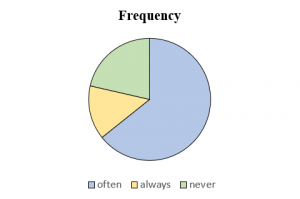
Fig. 1. Pie chart of the frequency of using English names among Chinese students at Wake Forest University
Over 85 percent of participants either got their English names from English teachers or themselves (see table 2). It sounds weird to name oneself, but it is a common way to get an English name. Many of them found a “good-looking” name on the last few pages of the dictionary where there is a list of names; some searched online, and some simply adopted the name of their favorite movie characters or game avatars. Usually, in English classes, students would use the English names for a better learning atmosphere. Students who don’t already have a name often ask the advice of their English teachers.
Most Chinese students coming to Wake Forest University can speak and write in English fluently, which means they had received a decent level of English language education. It is reasonable to assume that many of them get assigned names in class by their teachers.
Two participants have English names given to them by their parents a long while back. Both of them used the names frequently before college and have a clear preference toward using their English names today. Interestingly, one of them has a Chinese name that is very easy to pronounce. As mentioned above, students usually stick with their original names if they could be easily pronounced. But this student insists on going by her English name. This, to some extent, reveals the undeniable influence of parents in naming their children.
Table 2
Origins of English Names Among 14 Chinese Students at Wake Forest University
|
Origin |
Number |
Percentage |
|
self |
6 |
42.9 |
|
parents |
2 |
14.3 |
|
teacher |
6 |
42.9 |
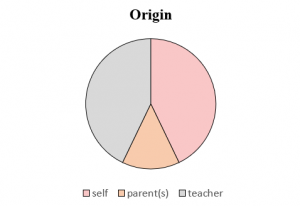
Fig. 2. Pie chart of origins of English names among 14 Chinese students at Wake Forest University
Discussion
Indeed, the name is a representation of identity (Edwards). This is universal, applicable to both Eastern and Western people. The result of my informal research, in fact, indicates that Chinese people may have a stronger connection between name and identity. Several participants mentioned that they go by Chinese names with Chinese friends, and go by English names when spending time with American friends. In these two situations, the students’ identity remains the same, the only difference being the nationality of their friends. Instead of viewing their English names as another form of personal name, most Chinese students recognize it as a nickname—unofficial and unrepresentative. Using a nickname does not eliminate the existence and significance of their original name, and it does not change who they are as people. The use of an English name protects their original names, which are closely connected to their family, culture, past experience, and personalities, from being mispronounced and misunderstood. Using English names is actually a method to protect their original names as social identity. This explains why, despite the Chinese peoples’ care in choosing names, Chinese students abroad have the tendency to use English names. Nevertheless, those who get their English names from their parents—just as they got their Chinese names—already view these names as their originals names, thus part of their identity.
When asked about preference, many participants claimed that they do not have a clear preference. Their behavior, however, indicates that they may actually be fond of one over the other. For example, some participants only introduced their last name and English name to American professors and friends, and did not even mention their Chinese name. The psychological reasoning behind this phenomenon requires further exploration.
As an international student studying in the U.S., I love to see and experience the diverse cultures on college campuses. But I am also aware of certain cultural barriers between students from different countries that might lead to stereotypes and misunderstanding. I did this research aiming to find the explanation behind Chinese students’ name usage. Starting from this, I want to investigate more deeply into the influence of culture on people’s behavior and habits, and minimize the gap between international students and domestic students at Wake Forest.
Works Cited
Edwards, Rachel. “What’s in a Name? Chinese Learners and the Practice of Adopting ‘English’ Names.” Language,
Culture and Curriculum, vol. 19, no. 1, 2006, pp. 90–103. ProQuest,
https://search.proquest.com/llba/docview/85645169/E2952DA459D46B2PQ/3. Accessed 24 Oct 2018.
Pennesi, Karen. “‘They Can Learn to Say My Name’: Redistributing Responsibility for Integrating Immigrants to
Canada.” Anthropologica; Waterloo, vol. 58, no. 1, 2016, pp. 46–59. ProQuest,
https://search.proquest.com/socabs/docview/1805465455/abstract/A3B13CEA0C224181PQ/1. Accessed 24 Oct 2018.
A Word from Aiai
 I consider myself an efficient student, except when I am writing essays. It takes forever for me to brainstorm a topic, build structure, and then construct the draft. On the due date, I often sit in the lounge, typing my words alone until 5 a.m. In college, however, my writing process evolved after taking Writing 111. With the help from Dr. Smart, my writing professor, the writing process, especially finding inspiration, became a lot smoother.
When doing the second project for Writing 111, I had some trouble. Other students were finishing their first drafts, while I was still unsure about my topic. The idea suddenly sparked during an office hour with Dr. Smart, when we were talking about the interesting stories surrounding my name. I used to have an English name in high school, but most of my friends and professors prefer to call me by my Chinese name because it’s easy to memorize and pronounce. Almost everyone was confused when they first heard my name. My first name—“Aiai”—is so unique that I don’t think anyone in China has the same name as I do. I believe that many people, especially international students, have their own stories with names. Sadly, due to the limitation of sample size and diversity, the result of my informal research could not be more detailed. But I would love to learn more about the psychological and cultural influences on the connection between name and identity in the future.
The original prompt of this assignment was about language analysis on one’s own writing, but Dr. Smart was so kind that he allowed me to write on the use of names. He encouraged me to find inspiration from minor things in life, and to be brave to try, even when it seemed to be irrelevant to the original prompt.
Another reason I determined to write on this topic is because name usage can reflect people’s cultural background. I am working for a student-run organization that aims to build connections between international and domestic students. I hope to employ names as an example to raise people’s awareness of cultural diversity on campus.
From Professor Smart
Assignment
For this writing project, you will analyze real language samples and make an argument about the variety of English based on your findings. For this project, I recommend one of two options:
-
Compile and analyze a small, principled collection of language samples to analyze or compare how language is used. For example, you may want to build a collection of oral stories from CNCC (below) to look at how speakers begin spoken language narratives. Alternatively, you may want to look at how different news organizations covered the same news story, so you could compile a corpus of news stories. If you want to see how speaking roles differ between genders, you could create a small corpus of movie scripts.
-
Analyze your own language use. Compile a small corpus of your previous essays or writing samples (at least five) and examine the content and language use for trends in your own writing. What trends do you notice? What observations can you make about the vocabulary or sentence structures you use? How does your language use relate to organization and content of your writing?
Your paper should make an argument that is well-supported by both examples from the language samples and three or more academic sources. Two sources can be from a course reading, but the other sources should be from academic journals or books. The paper should be 3-4 pages long (double-spaced) and following the formatting conventions for the course. Additionally, the paper must include the following sections, which should be labeled with headers:
-
Abstract: a 150-word overview of the project, including a summary of each of the sections below
-
Introduction: review the previous literature on the topic, explain the research question and the rationale for your project.
-
Method: Explain the method you used to analyze the language sample(s).
-
Results: Report the results transparently and objectively. Provide representative examples from your data/analysis. Include tables, figures, or images where appropriate.
-
Discussion: Discuss what conclusions can be made based on the results, along with limitations of the research and/or questions that could be addressed in further studies.
Professor Commentary
One thing that makes Aiai’s essay stand out is how personal the topic is for her. For this assignment, each writing student had to analyze an area of language study. Aiai regularly came by my office hours to brainstorm ideas for her projects, and she hit upon the question of why some Chinese students at American universities use English names while others stick with their Chinese names. From our first informal chat, Aiai’s project developed into a much deeper and more realized exploration of language, identity, and self-representation. This central, compelling question of her research is both academic and immediately relevant to the author and her audience. The essay itself follows the genre conventions of a research study, but Aiai makes the reader care about this small case study through her own personal stake in the topic and through careful analysis of the topic. The diversity of attitudes and experiences that her subjects shared was a surprising finding from this study, and it was made all the more interesting by the author’s transparent, methodological writing style.