

A Week in the Life of a Perfectly Normal College Student Who Does Perfectly Normal Things
By Chris Verrill
Writing 212: The Art of the Essay
Monday, the 20th
8:30 a.m.Today I am a nihilist.
Every action is a performance layered over a void of uselessness. Every opinion is untenable. Years of telling myself to hold multiple ideas in my head has hollowed out my set of beliefs and now I will commit to no idea, no worldview, nothing. All these routines I and others perform are leading to no end.
I am averse to just performing life, but I cannot see where the line blurs into what is real. I feel small, and that all my actions are insignificant.
For a moment, I consider quitting all of it. Instead, I pick up my coffee from the Keurig.
9:23 a.m.
In my international politics class, we discuss Bitcoin. Bitcoin has little or nothing to do with the real world and I am not feeling much better.
10 a.m.
Update: I have listened to The Dear Hunter’s “A Sea of Solid Earth” and while my problems are not solved, I feel made whole enough, and I keep on:
A final breath with tongue in cheek
Crossed the sun with sullen speak
Make no mistake, it weighs on me
The choice is made, echo and ring
I eat a bagel loaded with cream cheese as a part of my breakfast and tell myself that this week I will be strong enough to not eat a bagel loaded with cream cheese for breakfast every day.
Along the way I was reminded how much I value The Dear Hunter’s epic-poetry-as-song and listen to another EP, Violet. I pull out my laptop and pretend to work, somewhat ashamed by the very diligent guy in the next booth.
11:35 a.m.
During this linguistics lecture on the origin of language, I am considering a career in linguistics.
12:24 p.m.
As our class discusses Catullus, I am considering a career in Latin.
2:20 p.m.
More coffee. I am shamefully proud that the barista knows my name and regular order.
As I wait for my Grande cappuccino, I feel complicit in a system I hate. I sense the tension, inherent in working a low-wage job for hours at a time, between the baristas. It does not spill over into the coffee-centric aesthetic of the rest of the store. At some point, an actual commodity—coffee—commodified an entire aesthetic, an entire sub-culture. As this is a sub-culture I like to partly claim, I feel torn.
How can I enjoy something I feel, at best, morally apprehensive about? How can I be something like that?
2:30 p.m.
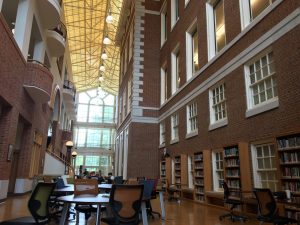
I am sitting in the library, not secluded enough, waiting to be a college-educated adult (a process preferably undergone by osmosis). After ten minutes of scrolling through Twitter, I resign to the fact that sitting here will not college-educate me, and I open a textbook. This week, my international politics class is discussing the environment:
Antarctica is a Success Story in terms of international cooperation, but virtually every other square inch of this planet is not. Environmental degradation seems necessary for a growing economy, and so economic incentives move us toward self-destruction. This is what’s known as the Collective Action Problem, the Prisoner’s Dilemma, or the Tragedy of the Commons. Essentially, it is in our collective interest to stop emitting toxic gases. At the same time, it is in everyone’s interest to emit as much toxic gas as possible, to grow their economy. In other words, the Commons is the shared space that we all inhabit; the Tragedy is that, depending on whom you talk to, it is too late, or it will be too late soon. It is difficult to say precisely what effects I will feel from environmental degradation, but we will certainly feel repercussions. The problem is that I am not we.
3:30-6:15 p.m.
I have two rehearsals with two different college bands. After reading about a threat to civilization, three hours spent playing the French horn feel small and insignificant, almost maddeningly so.
7:34 p.m.
Once more unto the library.
Scholars in international relations have theorized that there is only once scenario where a world government might form: the revelation of intelligent extraterrestrial life. It seems almost a requirement of our psyche that we “other” someone; for our identity to be coherent, there needs to be a negative, an opposite of that identity. As identity is a strong pillar of the state, without identity, there is no state. Without some force moving us to have a shared identity as humans, there is no world government.
Without a world government, war rages, and the planet heats up.
10:00 p.m.
My roommate is watching all seven Star Wars movies, one each night, in preparation for the new movie. I tell myself I will go to sleep about two hours before I actually do.
* * * * *
Tuesday
8:03 a.m.
Today I am only half a nihilist: my 4-6 p.m. practice was canceled.
My morning routine, usually twenty to thirty minutes, takes a full hour. I stare at what I want to wear, but I am mentally elsewhere, working through a number of hypothetical (and improbable) conversations I could have today. Something from “The Second Coming” by Yeats is in illogical and cruel juxtaposition with these thoughts:
…somewhere in sands of the desert
A shape with lion body and the head of a man,
A gaze blank and pitiless as the sun,
Is moving its slow thighs, while all about it
Reel shadows of the indignant desert birds.
12:29 p.m.
I have finished a jog, and despite showering, I feel self-conscious about how I must look to everyone else sitting in this 12:30 class.
1:20 p.m.
During this lecture on 18th-century English literature, I consider quitting my life and moving to England to become a full-time expert on gothic literature.
1:47 p.m.
I head to the library, where I (regrettably) will not quit my life to become a full-time expert on gothic literature.
2:20 p.m.
When I throw away my coffee cup, I wonder what happens to it.Consumerism has gifted us the Great Pacific garbage patch that, according to its Wikipedia page, was “discovered” between 1985 and 1988. Estimates of its size range from 700,000 square kilometers (about the size of Texas) to 15,000,000 square kilometers (considerably bigger than Texas). It is a kind of soup, with trash (mostly plastic) floating around at various sizes (mostly microscopic). Still, even microscopic pieces of plastic can absorb various toxins and can be consumed by fish, which then are consumed by us (though not me).
6:00 p.m.
One of the underrated perks of college is the ability to sit down and read or work or write for hours at a time. This was not possible in high school and, at least for me, was not possible at home, either.
8:00 p.m.
In a phone call, my dad and I briefly discuss politics. He asks me for my opinion about an element of a new tax plan moving through Congress; it would not allow graduate students to claim a certain deduction, in effect making graduate school less accessible (I believe). I accidentally call it the “Republican tax plan” instead of “Congress’s tax plan” or “the tax plan” and the conversation, like a frightened deer, skidders onto some other topic.
* * * * *
Wednesday
8:00 a.m.
The day sweeps me along before I have any time for today’s self-realization. I hardly have time to warm up my Keurig.
10:03 a.m.
This is my third bagel, and I have some regret, though not much.
It has been two days, which means enough time has passed that I can allow myself to listen to A Sea of Solid Earth again (I must exercise some forbearance; consuming too much of something ruins it).
Make no mistake, it weighs on me
The choice is made, echo and ring
The song is from the EP Orange. The music that invokes an earthy, dirty orange and the guitar that weeps so grandly brings something else to my mind, a fragment:
And on the pedestal, these words appear:
My name is Ozymandias, King of Kings;
Look on my Works, ye Mighty, and despair!
Nothing beside remains. Round the decay
Of that colossal Wreck, boundless and bare
The lone and level sands stretch far away.
11:30 a.m.
A weird coincidence:
My linguistics professor has assigned a book by a man named Steven Pinker that serves as a witty and dense introduction to linguistics. I read it and am convinced that Pinker is a linguistics professor. My international politics professor, on the same day, recommended a book by the same Pinker about the decline of warfare (Our Better Angels, I believe). It is remarkable to me that one man could be so versed in two so radically different fields.
The quirk that I should simultaneously be introduced to him in two different classes implicitly reminds me that I am Reality’s Protagonist.
12:30 p.m.
In my years of high school and college, I have taken six semesters of Latin, and this is the final one. Only now am I starting to grasp the language. I am mostly comfortable with weird word order and can translate several sentences without consulting a dictionary. In a couple of months, this skill will lapse and eventually become next to useless, but for now I feel powerful.
I again consider pursuing a degree in the classics.
2:45 p.m.
I look up and realize I have spent the past half hour scrolling through Twitter. I was reading tweets from a climate scientist, explaining the effect of global warming on natural disasters through analogy:
Imagine if gravity became marginally stronger. You would fall only marginally more often, and you would fall only marginally harder. When you did fall, you wouldn’t be able to point to that isolated event and say See! The increase in gravity caused this! You would just be slightly more likely to require an ER visit. Eventually, you would lose your balance much more than you normally would. In time, buildings would start to crumble, first in poorer countries, where infrastructure hasn’t had the time or political power to be developed. Perhaps we would adjust; perhaps not.
If the atmosphere warms up, it can hold somewhat more water, and is somewhat more volatile. Sometimes it rains slightly harder; sometimes Puerto Rico loses their power grid for months. It’s a system-wide change, slow, slouching, with reeling shadows of indignant desert birds.
3:26 p.m.
I go to wind ensemble practice. It is not something I particularly enjoy, but I am the only horn player at this university; in the interest of not making an enemy of the music department, I attend.
2:09 a.m.
I am in the library and suddenly I am, again, a nihilist.
* * * * *
Thursday
8:30 a.m.
I am late, but, for some reason, I cannot bring myself to move quickly.
I pause in front of my Keurig. I have seen enough headlines to know that these pods are probably terrible for the environment. As I throw my pod away, I remember that something like 13 billion pods get thrown into landfills each year, and that they are not bio-degradable or recyclable. I am also acutely aware of my own inability to value water; coffee is a water-intensive crop. While these pods are as water-efficient as possible, each one still consumes liters of water, itself a commodity in countries with subpar infrastructure.
It is true that the future of human civilization will not be determined on whether I use coffee pods and a Keurig. It is true that coffee is quite addictive.
11:45 a.m.
Mining Bitcoin requires massive amounts of computer power, which requires massive amounts of energy, which requires massive amounts of coal and petroleum. The entire mining operation of Bitcoin is consuming roughly the same amount of energy that Denmark does. Put another way: civilization is now a tool for converting coal and petroleum into invisible (and, if and when the bubble pops, next to worthless) currency.
My name is Ozymandias, King of Kings;
Look on my Works, ye Mighty, and despair!
4:55 p.m.
During this marching band rehearsal, every inch, every second, is magnificently consequential.
In a somewhat uncharacteristic (yet highly expected) move, the directors stop the rehearsal to explicitly demand our respect. I wonder if leadership is a myth.
10:04 p.m.
I have learned my roommate has some controversial (read: wrong) opinions about the Star Wars prequels.
* * * * *
Friday
10:13 a.m.
Shamefully, I load my fifth bagel with cream cheese.
12:20 a.m.
As we translate Catullus, I reflect on how utterly similar he is to me and others I know.
There’s a new book I’ve seen floating around on Twitter that suggests the fall of the Roman empire was in part due to climate change. In short, a drier climate made disease more rampant, which made central Asia less easy to live in, which caused the Huns to move west, which caused the Goths in turn to move west and ransack Rome. The changing climate also likely triggered a Roman Black Death. The book (The Fate of Rome, by Kyle Harper) proposes viewing the Roman era as the exception rather than the rule; while the Romans conquered, the climate was unusually warm, wet, and stable. When things shifted, the Romans realized they had built their house on sand.
The industrial revolution would not be for millennia; humanity did not drive this climate change. It is a scary thought: our existence is not guaranteed. Our planet—nature itself—is not stable, is not here for us.
1:52 p.m.
I have spent a good deal of money on coffee this week.
There is a website that can tell you how many earths would be required for everyone to live like you. I am in college and do not need to drive or buy furniture, and I am also a vegetarian: my number is low, at 1.6 earths. When I was in high school (and I ate meat and I drove an hour or two every day), the number was closer to 5. If everyone lived like I do now, starting January 1st, the earth would be completely exhausted of natural resources by August 16th.
3:45 p.m.
An anomaly: I can save most of my work for Sunday, so I watch a couple of episodes of The Good Place.
5:00 p.m.
As I move into the weekend, I will drive my car and consume a lot of coffee. Nihilism is currently an urgent problem, so I will use most of my spare mental energy to search for meaning.The choice is made, echo and ring
Works Cited
Shelley, Percy B. “Ozymandias.” The Norton Anthology of English Literature. Gen. ed. M.H. Abrams. 7th ed. Vol. 2. New York: Norton, 2000. 726. Print.
The Dear Hunter. “A Sea of Solid Earth.” Orange, Triple Crown Records, 2011.
Yeats, William Butler. “The Second Coming.” The Norton Anthology of English Literature. Gen. ed. M.H. Abrams. 7th ed. Vol. 2. New York: Norton, 2000. 2107. Print.
A Word from Chris
My biggest challenge in writing classes is writing about myself. Focusing all of my thoughts, experiences, and emotions into a real-life person who is both coherent and unique is scary. In some ways, this piece is a response to that fear. Writing this was easy in some ways: I relied on my personal experience, so it was easier to avoid hedging my ideas. In many essays I write, I shy away from making larger knowledge claims; here, it was easier because the essay is more rooted in what I do than what I think (though, of course, what I think is on display). The structure of a log here also helped me be more confident.
What made this essay easier also made it more difficult. When writing, I still shied away from what my real experience was; although most of what I have written is rooted in real experience, I have never lived a week even remotely like this. During the process of creating this piece, I have discovered a kind of strength in fiction. If I write down something that is not real (or here, something that is adjacent to what is real), I feel more confident in standing behind what I have written and asserting my ideas.
When I sat down and started to write a lyric essay, all I knew is that I wanted my form to have something to do with my argument. I discovered that this form, something between a log and a diary, could be effective at highlighting a tension between big and small problems. Crucially, I did not arrive at a resolution (at the beginning, I was not sure if I would). The potential impossibility of resolution is something I think the structure of this essay would help tease out. Still, despite some pessimism, I hope there is a point of reverberation in the essay that is meaningful.
From Professor Carter Smith
Assignment
Adapted from an assignment sheet composed by Laura Giovanelli.
Deborah Tall and John D’Agata, editors of Seneca Review, a well-known literary magazine that often features lyric essays, claim that lyric essays walk the margin between poetry and prose. Walking the margin, though, the form doesn’t conform wholly to one genre or the other. Lyric essays are often more fragmentary in structure than the other genres we’ve explored thus far; they can also more heavily rely on rhythm and sound, which points back to this genre’s name, lyric, from lyre, a stringed musical instrument that accompanied ancient Greek singers.
And yet, that doesn’t mean that lyric essays don’t serve a similar purpose as other essays. In this subgenre, essayists play with structure to reach their readers; the essay’s form is another rhetorical choice, part of the argument. That’s your purpose here: to write an essay that that makes its form a necessary part of its argument, of the statement that it wants to make. Examples of lyric essays that we’ll be reading include hermit crab essays, collages, braided essays, and prose poems.
As the final piece of writing for this class, I also want you to include a reflection, in the form of a cover letter or afterword, that articulates how the lyric essay you’ve written fits (or doesn’t!) within the wider genre of the personal essay as we’ve discussed it this semester. Make a specific, convincing argument about how the form that you’ve chosen does (or doesn’t do) what an essay is supposed to do and prove it with precise evidence from your lyric essay and the other readings we’ve encountered this semester.
Make it exciting and impressive and great!
Professor Commentary
Our class read Eula Biss’s “The Pain Scale” on the way to this lyric essay assignment, the final one of the semester. I remember Chris saying about Biss’s essay that it depends so much on the resonance between its sections, a forward momentum that brings together the conspicuously various strands of its argument. Chris’s essay makes that move convincingly, too, though I’d want to suggest that one of the things I admire most in this piece is that it doesn’t feel like it’s making moves at all. The stakes of “A Week in the Life . . .”—intellectual identity, economy, civilizational and ecological catastrophe—are compelling on their own terms. The essay is a vulnerable, real account of what it’s like to be a student, happily engaging with ideas, but also punctured by them. It allows its reader to see and feel the difficulty of that situation, and I’m thankful for that.