


A Message from the Stars
By Elizabeth Wood
Writing 111: Writing Seminar
There I stood on foreign land
I tilted my neck and raised my eyes
To a mystery yet unsolved by man
The great, deep, and dark night’s sky.
Though here on Earth my path is lit
By hundreds of thousands of stars
That show themselves in an endless pit
Of galaxies near and far.
I think of faith and truth thereof
And what I truly know
Upon watching space and stars therein
Who, for me, surely glow.
I know not why I’m here on Earth,
Not elsewhere in the sky;
I know not what’s beyond the stars
That light this world of mine.
I know not of a point to life
Therefore, I’m forced to guess;
I think and seek and think and seek
But nothing I can detect.
It is then that I make up my mind
To live life to the full;
For when my consciousness ceases,
I wish it’s not been dull.
If life gives joy I will be glad
Although sorrow alike
Will serve its purpose in tandem
Of making me feel alive.
I welcome joy with open arms
And anger and sorrow and pain
For I do not know if the meaning of life
Is simply to feel the rain.
“Panama” (04/17/17)
Thirteen point six billion years ago, the universe was dark. For 200 million years, all of existence consisted of a vast, infinitely expanding void of near nothingness, with a few particles of somethingness here and there. Then something incredible happened: out of the empty nothingness of the universe came masses of light and heat, without which there would be no planets, no Earth, no life, no humanity. What is more, of the 100 billion stars which the universe has created for us, but one is needed to sustain life. One star gave rise to you and to me and has continued to light our world every day, a star which we call the Sun. As its path moves from us each night, however, we are not left without light. The vast darkness above us provides light from thousands of stars, some of which no longer exist but are so far away that the light they emitted a thousand years ago is just now reaching us. And so, the universe has provided us with this reminder: there is light within the infinite darkness.
It is by this thought that the stars allure me. I am drawn to their beauty, to their mystique. Although I once believed there was nothing special about a few stars in the sky, annual camping trips with my family have shown me otherwise. These camping trips have sparked my love for nature and inspired my fascination with the stars, both of which I did not appreciate until I was about 10 years old. Before then, I complained of foot pain on hikes, bugs, feeling too hot or too cold. My hiking boots rubbed my heels in a way that gave them blisters. My jacket made me sweat, but I didn’t want to carry it. And then, in one single night, my dread for camping turned to euphoria with the help of the vast abundance of stars. Never before had I seen so many! Why did this part of the sky have many more stars than the part of the sky that I saw at home? As my parents and brother and I sat around the campfire, wool blankets on our laps and hands sticky from roasting marshmallows, my dad explained to me that I was not, in fact, seeing a different part of the sky. “The sky that we see is all one,” he described, “and these same stars are still there at home, we just cannot see them. Out here deep in nature, there are no city lights to interfere with our view of the stars.” While their incredible array provided me with a deep sense of both optimism and peace that night, their disappearance upon returning home left me feeling not only unsatisfied, but also angry. I wanted to be able to see the stars like this every night. Others were living in naivety, and I wanted them to discover the truth about stars as I had.
Ever since that night, the stars have revealed themselves to me while camping time and time again, compelling my anger to deepen. The loss of stars has led me to feel angry towards civilization for forgetting about them, and it has led me to pursue answers as to why we cannot see stars in a city. Furthermore, it has compelled me to question whether the benefits of modern technology are worth the price of losing the sight of stars. In my exploration, I have found mostly objective reasons why we cannot see stars in a city, but the implications of the loss of starlight are subjective.
There are several reasons that most stars are invisible in a city, each of which falls under the objective category of light pollution. According to Lockwood, light pollution is the phenomenon in which artificial light from street lamps, buildings, houses, or the like streams into the atmosphere and blocks our natural view of space. This phenomenon is similar to that of driving at night when another car comes towards you with its bright lights on; the glare impairs your vision of objects in the darkness around you that you would otherwise be able to see. On a larger scale, artificial lights from cities and on streets are so bright that we can only see the dull glow of ten or fewer of the thousands of stars above us. Ninety-nine percent of the U.S. population is affected by light pollution, but we are not alone. Few people realize that this phenomenon afflicts not only the human population but also that of plant and animal species across the globe (Lockwood, sec. headnote).
Light pollution is seemingly harmless. It is reasonable to assume that because it is just light, it does not affect air composition the way that other pollutants, such as burning coal, do. In fact, unlike gases or smoke, in many countries, light pollution is not legally considered a “statutory nuisance” (Dewar, para. 9). Under the United Kingdom’s Environmental Protection Act, for example, a statutory nuisance is defined as anything that affects one’s property or health (National Archives). Many believe, therefore, that sheer light cannot harm the natural environment, and thus, its only loss is aesthetic. We are the only known species that values art and beauty the way that we do, and although we no longer need constellations to serve a practical purpose such as navigation and orientation, we innately recognize the beauty of their abundance and are drawn to its aesthetic. One might argue that this alone is not a strong enough reason to preserve stars at the cost of eliminating artificial light, which is imperative in our modern world. Artificial light is necessary for driving at night and for other safety precautions, such as preventing crime, among others. Light pollution will not harm us, most believe, but the lack of artificial light will.
Few realize, however, that light pollution is actually extremely detrimental to both human individuals and other species as well. One study published in Global Change Biology found that “in free-living animals, light pollution is associated with changes in circadian, reproductive, and social behavior” and that it “affects disease dynamics [among free-ranging wild animals]” (Ouyang, et al., abstract). In other words, light pollution is affecting the day-night cycle of animals, the implications of which are broader than expected. When the sleep cycle within a 24-hour day is disturbed, social behavior and the ability to reproduce are also disturbed, and each of these factors contributes to the onset of disease in animals. Not only does light pollution affect animal species, but it also is detrimental for humans. Light pollution most obviously leads to sleep deprivation for us, but that is not all. Sleep deprivation may seem insignificant, but caused by light pollution in the long term, it has been linked to chronic diseases, such as heart conditions and cancer (Lockwood, para. 5). It is clear, therefore, that light pollution is not harmless. Its significant effect is not to be neglected. We must examine the ways in which light pollution can be reduced, not only because the galaxy is extraordinarily beautiful, but also because our failure to do so is detrimental to our health and to that of plant and animal species globally.
According to scientist Charles Lockwood of the American Planning Association, reducing light pollution is relatively easy. It can be done, he believes, with four simple steps. First and foremost, the wattage of outdoor lighting should be reduced. Most porch lights, for example, use a 60 or 75-watt bulb when only about 40 watts are necessary. Lockwood notes that outdoor lighting manufacturers are all developing “dark sky friendly lighting,” and he suggests that both individuals and municipal subsidiaries can easily make an effort to implement this. Secondly, light pollution can be reduced by simply directing the light from street lamps downward to help reduce the spread of light where it is not needed. Similarly, the third step is to shield the light with “cutoff lights,” which shine from the sides and bottom of a fixture so that it does not shine up into the sky. Lastly, Lockwood suggests lowering the height of the light pole to further concentrate the stream of light (Lockwood, page 2). Individuals, like yourself, can and should take these steps to reduce their contribution to light pollution. On a larger scale, moreover, governmental adoption of these practices, as well as others which they deem necessary as light pollution ordinances, will reduce light pollution globally and help to restore our beautiful stars.
My anger towards society for enabling light pollution is pacified with the knowledge that the problem can be mostly undone. So long as it persists, we should implore local and federal governments to establish light pollution-reduction ordinances. And so long as it persists, we must make every effort to eliminate our individual contribution to its existence. The vast majority of future generations will live their entire lives having never seen the Milky Way galaxy; it will be difficult for them to even recognize that this is a problem – one not of what we can see but what we cannot (Lockwood para. 1). If they cannot see the galaxy for themselves, we must tell them our stories. We must not let them forget it.
This brings me to the culmination of my love story with stars, to the story I will tell my children and my grandchildren. It was January of 2017 and the beginning of the end of high school. Nine peers, two teachers, and I backpacked through the rainforest and mountains of Panama for three weeks, during which time something incredible happened; it was as if my demand for knowledge and answers morphed into a simple curiosity and awe towards the universe. Up to that point I had lived my life with a sense of existential disquietude, with a dissatisfaction arising from my idea that I will never possess objective, definitive answers regarding the meaning of life. On January 12th, 2017, this changed.
It was night, and we had no means for telling time, but for hours, my peers and I lay on the black-sand beach of a small, uninhabited peninsula in the Darien. Our hair was dirty, and our feet and backs were sore from hiking, and to rest on the soft ground felt surprisingly therapeutic. The cool sand relieved our backs as it molded to the shape of our bodies like a memory foam mattress. The fresh ocean smell overcame that of the layer of dirt and sweat that had accumulated over each of our bodies during our long day’s hike. In some moments we discussed our coming graduation and its implications, what we wanted to do with our lives, what it meant to live and die. In other moments we were silent, listening to the sounds of the ocean and jungle and mesmerized by the universe above and around. Above me was the most breathtaking array of stars I have ever seen and may ever. Millions of white dots infiltrated the infinite nothingness, several of them shooting briefly here and there. As I lay silent and motionless, they began to hypnotize me, pulling me towards them, making me feel as if I were among them. I realized that I was among them, that I was an infinitesimal fleck in the spectrum of the universe. I existed in the universe, and I need not know why or why the universe itself existed. All that mattered was that we did, and that I appreciated it. Now, over a year later I have not forgotten, nor ever will forget, my message from the stars:
I welcome joy with open arms
And anger and sorrow and pain
For I do not know if the meaning of life
Is simply to feel the rain.
Works Cited
Dewar, David. “MPs Demand the Right to a Clear Sky at Night.” Planning; London, no. 1541, Oct. 2003, p. 9.
“Environmental Protection Act 1990.” The National Archives, 1990, https://www.legislation.gov.uk/ukpga/1990/43/part/III.
Lockwood, Charles. “Let There (Not) Be Light.” Planning; Chicago, vol. 70, no. 3, Mar. 2004, pp. 22–24.
Ouyang, Jenny Q., et al. “Restless Roosts: Light Pollution Affects Behavior, Sleep, and Physiology in a Free-Living Songbird.” Global Change Biology, vol. 23, no. 11, Nov. 2017, pp. 4987–94. EBSCOhost, doi:10.1111/gcb.13756.
A Word from Elizabeth
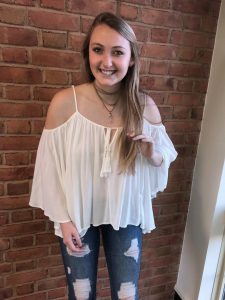
When prompted to write a narrative of advocacy, immediately I wondered what amazing story I could tell regarding a single event that changed my life, a story that advocates for something deeper with which everyone might easily agree. What was the hardest thing I’d ever been through, what is something many people are extremely passionate about, what is something amazing I’ve done? Nothing worthy came to mind. After days of pondering, it slowly dawned on me that I was approaching the essay with the wrong questions. An essay that tells an amazing story of an incredible accomplishment or horrific tragedy will not likely be able to advocate for anything unusual. Furthermore, I need not advocate for something that many people already care about; instead, it is my job to recreate in others that same passion that I myself hold about the issue. And so I chose one that is near and dear to my heart: light pollution.
In my development as a writer, I have learned that my most well-written essays tend to be those with topics I care deeply about. Correspondingly, my worst essays are those with topics for which either I hastily chose, or I thought readers may care about, while I myself did not care much about them. If I had been prompted to write a narrative of advocacy early in high school, for example, I likely would have chosen to write about suicide prevention, gun laws, sexual assault awareness, or the like. Each of these is a major issue that others may be likely to relate to, but for each I am hardly qualified to narrate a personal story that will do the issue justice. I would be lacking a deeply-rooted passion behind the topic, and it would be difficult to forge one. By comparison, light pollution is a regularly unnoticed phenomenon, and it is seemingly impersonal; thus, to advocate against it through narrative is difficult. Nonetheless, the advocacy is made tremendously less difficult because I am passionate about it, and, in fact, that others are not as passionate, I have learned, is what gives me a reason to write.
From Professor Elisabeth Whitehead
Assignment
Writing the truth is a political act…If you write the truth you will change the world. If you write privately, you change your own inner world, and that changes the outer world. If you write publically, you give voice to what is, and that assists what is becoming.
–Pat Schneider
For your third paper, develop an argument built on the foundation of personal narrative on an issue of concern to you.
Narrative arguments make it possible for writers to illustrate a point by appealing to their audience, invoking experience, and creating a sense of identification with the controversy at hand. Key to creating an effective narrative argument is establishing credibility (your audience must believe you and trust your presentation) and establishing representativeness (the audience needs to understand that your narrative reflects a larger problem beyond the scope of its events).
Choose a subject that is tightly focused. You will want to keep your work balanced rhetorically by accompanying the emotional appeal of your story with strong credibility and with logical evidence (both anecdotal and researched) to support your claims.
Think in terms of an experience that made you realize that something was wrong or that something needed to be changed, and from which you gained essential knowledge about yourself and about the workings of the world around you. Tell a story that allows you to establish your position on the controversy and provide support for your claims. A well-told story often engages in vivid description. Create presence in your details. Your readers should really feel that they too, by reading your account, are there beside you, and can hear, see, smell, and touch those surroundings. Clean and vivid details can help set scene and tone. Therefore, be specific, descriptive, and engaging.
Successful papers will provide a rhetorically balanced narrative argument and will be clearly and engagingly written. You should conduct enough research to provide relevant, external support for your position. Your paper should include at least three sources (books, magazines, journals, newspapers, interviews, films, and/or texts from the academic databases), but use as many sources as you need. One of your sources can be from a credible website. At least one of your sources must be from the databases. If you choose to use more than three sources, you can use additional website sources.
Using MLA style, incorporate in-text parenthetical citations and include a works cited page. Papers should be 5-7 pages long. In your folders include: final paper, two drafts with your changes marked, and a copy of your sources with your annotations. (Or you can include a copy/paste document with the source material you used, rather than printing out all of your sources. But I want to see all of your source information in its original form.) Your final grade for the paper will be reduced one step for each element that is missing.
Professor Commentary
During class discussions, I always looked forward to Elizabeth’s contributions. Not only is she intelligent, but she also articulates her ideas with keen precision and clarity, making her a strong communicator. This is also a quality I appreciate in her writing. In addition to her thoughtfulness, there is a conciseness in the writing, that results in an essay that feels sharp and distilled. Opening with a poem that is not specifically referenced again until the end of the essay, and deciding not to include a transition (other than the visual marker), might be considered a bold move. It disrupts, startles, and importantly, awakens the reader. As a result, when meeting the first line of prose, the reader is already curious about what will follow. Combined with the confidence and directness of the author’s voice, by the end of the first few lines of prose, I am already settled into the space of the essay. As a reader, I immediately trust this author and wait to be told her story. Elizabeth, from the beginning, speaks directly to us and invites us to be moved by her experiences. She also recognizes where she may meet resistance to her argument. She acknowledges that it is difficult to recognize a problem if it is one we quite literally cannot see. With this in mind, she addresses counterarguments and uses her research to reveal the danger light pollution poses to our health and the health of other plant and animal species. She also provides very specific and practical changes we can make in our own lives. But the most moving part of the essay for me is its conclusion. Using strong sensory details, she allows us to participate in this moment. We can feel our bodies, too, sinking into the cool sand, looking up to the stars and feeling the stillness, the expansiveness, and the awe of this scene. Culminating in a transformative experience, she writes of the stars that pull her toward them, of feeling connected to the universe, and of her gratitude for this. There is beauty and wisdom in the ending. Her advocacy is a combination of the informative and practical, but essentially feels spiritual in nature.